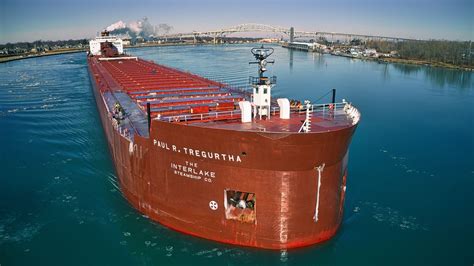
The 1,000-foot (or “thousand-footer”) ships used in the Great Lakes cannot transit the locks of the St. Lawrence Seaway due to size constraints. Here’s why:
Lock Size Limitations – The most significant locks on the St. Lawrence Seaway, such as the Eisenhower and Snell Locks, have maximum dimensions of 766 feet (233.6 meters) in length and 80 feet (24.4 meters) in width. In contrast, the largest ships on the Great Lakes, such as the Paul R. Tregurtha, measure over 1,000 feet (305 meters) long and 105 feet (32 meters) wide, making them too large to fit within the Seaway locks.
Seaway Max Vessel Size – The St. Lawrence Seaway has a specific vessel size limit known as “Seawaymax,” which is 740 feet (225.5 meters) long, 78 feet (23.8 meters) wide, and 26.5 feet (8.08 meters) in the draft. Thousand-footers far exceed these limits.
Great Lakes Bulk Shipping Focus—These massive ships were specifically designed to operate within the Great Lakes and are optimized for transporting iron ore, coal, and grain between ports on Lakes Superior, Michigan, Huron, and Erie. Since they are too large to exit through the Seaway, they only operate between ports that can accommodate them.
Alternative Routes & Economics—Instead of using the St. Lawrence Seaway, bulk goods carried by 1,000-footers are often transshipped at ports like Duluth, Superior, or Chicago onto smaller vessels or trains for export.



 Swansenreport
Leave a comment