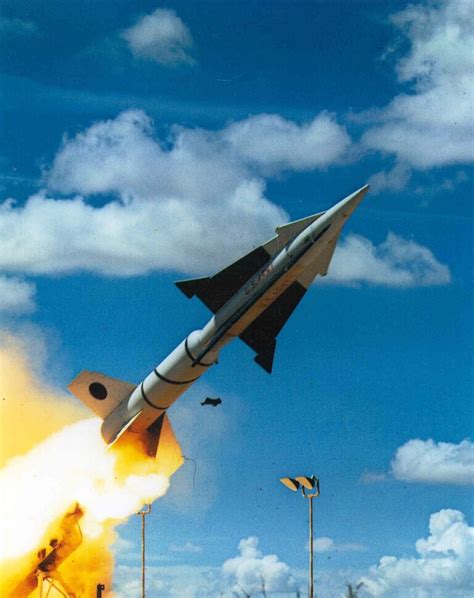
The Sprint missile was one of the most remarkable—and extreme—missiles ever developed during the Cold War. It was part of the United States’ nuclear missile defense program in the 1960s and 1970s. Let’s break it down:
Purpose
-
Sprint was an anti-ballistic missile (ABM) designed to intercept incoming Soviet nuclear warheads during the final moments of their descent (known as the “terminal phase”).
-
It was intended to protect U.S. cities, military bases, and missile silos from nuclear attack.
Design and Performance
-
Speed & Acceleration
-
Sprint was astonishingly fast. It could accelerate to Mach 10 (≈7,500 mph / 12,000 km/h) in under 5 seconds.
-
The acceleration was so extreme that the missile’s exterior heated up to 6,200 °F (≈3,400 °C), making it glow white-hot during flight.
-
-
Range & Flight Profile
-
Extremely short range: about 25–30 miles (40–48 km).
-
Maximum altitude: ~25 miles (40 km).
-
Sprint wasn’t designed to chase missiles across oceans—it was a last line of defense, fired when an enemy warhead was already reentering Earth’s atmosphere.
-
-
Guidance
-
Controlled via radio command guidance from powerful ground-based radars.
-
It had to respond within milliseconds, given how fast everything was moving.
-
-
Warhead
-
Carried a nuclear warhead (≈1–2 kilotons).
-
Because hitting a nuclear warhead directly at those speeds was nearly impossible, the Sprint relied on a small nuclear explosion to destroy or deflect the incoming ICBM warhead.
-
Deployment
-
Sprint was part of the Safeguard ABM system, which combined two layers:
-
Spartan missiles (longer range, exo-atmospheric intercepts).
-
Sprint missiles (short range, endgame intercepts).
-
-
In the 1970s, a Safeguard site with Sprint missiles was briefly operational in North Dakota, meant to protect U.S. intercontinental ballistic missile (ICBM) silos.
Problems and Limitations
-
Radiation Fallout
-
Detonating nuclear warheads above U.S. soil—even to intercept enemy missiles—risked spreading radioactive fallout across the very areas they were trying to defend.
-
-
Cost
-
The system was enormously expensive. Each missile, radar, and site required advanced (and costly) technology.
-
-
Arms Race Dynamics
-
The Soviet Union could simply build more warheads or deploy decoys, overwhelming the system.
-
-
Political Concerns
-
The 1972 Anti-Ballistic Missile (ABM) Treaty between the U.S. and the USSR limited deployment of such systems, as both nations recognized they destabilized nuclear deterrence.
-
Legacy
-
The Sprint missile is remembered as an engineering marvel:
-
One of the fastest-accelerating man-made objects ever built.
-
A weapon so extreme it pushed materials, electronics, and human ingenuity to the limit.
-
-
Its development contributed to U.S. understanding of hypersonic flight, thermal management, and radar guidance—knowledge that feeds into today’s missile defense and hypersonic research.
✅ In short: The Sprint missile was a blisteringly fast, nuclear-tipped interceptor designed to shoot down incoming Soviet warheads in their final seconds. Though technologically impressive, it was impractical, politically controversial, and short-lived—but it still stands as a striking symbol of Cold War nuclear brinkmanship.




 Swansenreport
Leave a comment