⭐
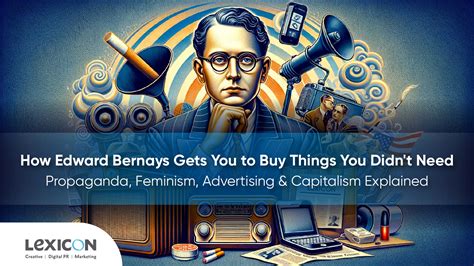
Who Was Edward Bernays?
-
Born in Vienna, nephew of Sigmund Freud (his mother was Freud’s sister).
-
Emigrated to the U.S. as a child and became a major figure in public relations after WWI.
-
Worked for government agencies, presidents, corporations, and foreign nations.
-
Lived to age 103, influencing the field through the entire 20th century.
His work combined:
-
Psychology
-
Mass persuasion
-
Sociology
-
Media manipulation
-
Political strategy
He believed that the masses are irrational and must be guided by an elite through psychological influence — a deeply controversial idea.
🎯
Bernays’ Core Beliefs (The Philosophy Behind His Work)
Bernays believed:
1. People are not guided by reason
Instead, they act on:
-
Emotion
-
Desire
-
Herd instinct
-
Subconscious impulses
This came directly from Freud’s theories.
2. Society must be “managed”
He argued that without an elite class using propaganda, democratic societies become chaotic.
This leads to his most famous claim:
“The conscious and intelligent manipulation of the organized habits and opinions of the masses is an important element in democratic society.”
3. Propaganda is not inherently evil
Bernays rebranded “propaganda” as public relations after World War I, claiming the techniques could be used for good or harm.
📘
Key Books
Bernays wrote multiple foundational works:
“Crystallizing Public Opinion” (1923)
Defines public relations as a scientific practice.
“Propaganda” (1928)
Explains how elites must shape public opinion; one of the most influential 20th-century works on mass persuasion.
“The Engineering of Consent” (1947–1955)
Describes PR as the “engineering” of public attitudes.
🛠️
Famous Campaigns & Techniques
Bernays wasn’t just a theorist — he ran some of the most creative and controversial PR campaigns in history.
1. “Torches of Freedom” (1929)
Goal: Increase cigarette sales among women for the American Tobacco Company.
Method:
-
Hired debutantes to march in NYC’s Easter Parade holding lit cigarettes.
-
Told reporters the women were lighting “torches of freedom” to symbolize gender equality.
Result:
-
Massive publicity.
-
Smoking among women skyrocketed.
This is now studied as a classic manipulation technique: attaching a product to a social movement.
2. The Bacon and Eggs American Breakfast (1920s)
Goal: Increase bacon sales for Beech-Nut.
Bernays surveyed doctors and publicized the “scientific” consensus that a hearty breakfast should include bacon and eggs.
Result:
The bacon-and-eggs breakfast became a standard American tradition.
3. United Fruit Company & the 1954 Guatemala Coup
Perhaps his most controversial role.
United Fruit (now Chiquita) hired Bernays to combat land reforms in Guatemala under President Jacobo Árbenz.
Bernays:
-
Developed a PR campaign portraying Árbenz as a communist threat.
-
Influenced U.S. newspapers, opinion leaders, and policymakers.
-
Helped create the climate for the CIA-backed coup in 1954.
This campaign stands as a prime example of PR used to justify political intervention.
4. Public Water Fluoridation
Bernays was involved in promoting fluoride in public water systems.
He framed fluoridation as modern, scientific, and good for childhood development — shaping public acceptance.
5. Rebranding the Word “Propaganda” to “Public Relations”
After World War I, the word “propaganda” had become negative due to its association with wartime deceit.
Bernays engineered the term “public relations” to sanitize and professionalize the discipline.
📡
Methods Bernays Innovated
Bernays pioneered many now-standard practices:
• Celebrity endorsements
• Staged media events
• Psychological profiling of audiences
• Opinion sampling and surveys
• Linking products to social issues
• Using experts to legitimize messages
• Manipulating news coverage through spectacle
He believed PR should operate much like psychoanalysis applied to the public.
🧨
Criticism of Bernays
Many see Bernays as a dangerous figure. Critiques include:
1. Belief in manipulating the public
Bernays saw average citizens as irrational and in need of guidance — a view some see as elitist or anti-democratic.
2. Use of subconscious manipulation
His techniques bypassed critical thinking.
3. Corporate power over public thought
Companies used his tools to shape desires and consumption habits.
4. Political interference
His work for United Fruit helped destabilize a government.
5. Propaganda disguised as “information”
He encouraged the use of “experts” to manipulate opinion under the appearance of neutrality.
🌍
Bernays’ Legacy Today
Edward Bernays effectively created:
-
Modern advertising
-
Corporate PR departments
-
Government public information offices
-
Political message framing
-
Viral marketing techniques
-
Consumer identity creation (“You are what you buy”)
His influence can be seen in:
-
Social media advertising
-
Political campaigns
-
Crisis communications
-
Corporate branding
-
Public health messaging
-
National-security information strategies
-
Behavioral science-driven advertising
His methods shaped the entire consumer and political culture of the 20th and 21st centuries.
📌
Summary
Edward Bernays was:
-
A pioneer of PR
-
A master of media manipulation
-
A student of Freudian psychology
-
A key figure in corporate and governmental persuasion
-
A creator of techniques still used in marketing and politics today
-
A controversial architect of mass manipulation
He is admired for his innovation but criticized for the ethical implications of his work.


 Swansenreport
Leave a comment