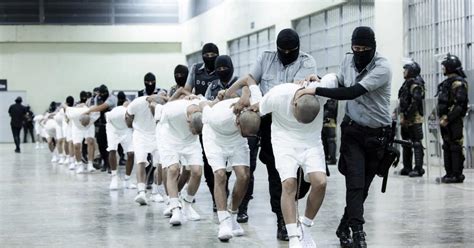
El Centro de Confinamiento del Terrorismo (CECOT)
CECOT is El Salvador’s maximum-security prison, built specifically to house gang members as part of President Nayib Bukele’s controversial crackdown on gang violence. Located in Tecoluca, about 74 kilometers southeast of San Salvador, it opened in early 2023 and has become one of the most restrictive detention facilities in the Western Hemisphere.
Design and Capacity
The facility was purpose-built to contain what the Salvadoran government calls “terrorists”—primarily members of MS-13 and Barrio 18, the two major gangs that have historically plagued El Salvador. CECOT can hold approximately 40,000 inmates, though initial reports suggested a designed capacity of around 40,000, making it one of the largest prisons in the Americas. The architecture emphasizes complete isolation and control, with eight separate buildings, reinforced concrete structures, and extensive surveillance systems.
Conditions and Restrictions
The conditions at CECOT are deliberately austere and punitive. Inmates experience:
- Extreme isolation: Prisoners are confined to their cells for 23-24 hours daily, with minimal outdoor time
- Restricted contact: No visits from family members, with extremely limited or no phone calls
- Surveillance: Constant monitoring through cameras and guards
- Overcrowding: Cells designed for small groups often house dozens of inmates sleeping on metal bunks
- Basic provisions: Minimal food rations, limited bedding, and restricted access to amenities
- Shaved heads and uniforms: All inmates have their heads shaved and wear white uniforms to eliminate gang identification
The regime prohibits tattoos from being visible and attempts to strip away all gang identity markers.
Legal and Political Context
CECOT operates under El Salvador’s “state of exception” (régimen de excepción), which Bukele’s government implemented in March 2022 following a spike in gang killings. This emergency decree suspended certain constitutional rights, including:
- Due process protections
- The right to legal defense during detention
- Restrictions on pretrial detention length
- Privacy protections
Under this framework, tens of thousands of people have been arrested, often with minimal evidence. While Bukele’s government claims these are verified gang members, human rights organizations have documented numerous cases of arbitrary detention, where people with no gang affiliation were imprisoned based on appearance, neighborhood, or tattoos.
International Reaction and Human Rights Concerns
Human rights organizations, including Amnesty International, Human Rights Watch, and the Inter-American Commission on Human Rights, have raised serious concerns about CECOT and El Salvador’s broader anti-gang strategy:
- Mass arbitrary detention: Estimates suggest thousands of innocent people have been imprisoned
- Torture and inhumane conditions: The extreme isolation and conditions may constitute cruel, inhuman, or degrading treatment
- Lack of due process: Many inmates have been detained without formal charges or trial
- Deaths in custody: Reports indicate hundreds of deaths within the prison system since the crackdown began
- Impossibility of legal recourse: Families struggle to locate detained relatives or access legal representation
Domestic Support
Despite international criticism, Bukele’s security policies enjoy overwhelming support within El Salvador. The country experienced dramatic reductions in homicide rates—from one of the world’s highest to among the lowest in Latin America. Many Salvadorans, exhausted by decades of gang terror that included extortion, murder, and control of entire neighborhoods, view the harsh measures as necessary. Bukele’s approval ratings have remained exceptionally high, and he won reelection in 2024 in a landslide, despite constitutional concerns about his eligibility.
Broader Implications
CECOT represents a significant experiment in punitive justice and raises fundamental questions about the balance between security and human rights. Supporters argue it has effectively neutralized gang structures that once controlled large portions of Salvadoran territory. Critics warn that mass incarceration without due process sets a dangerous precedent, potentially inspiring similar authoritarian measures elsewhere in Latin America, and that the underlying social and economic conditions that produce gang membership remain unaddressed.
The facility has become a symbol both of Bukele’s iron-fisted approach to governance and of the complex trade-offs many societies face when confronting severe organized crime.



 Swansenreport
Leave a comment