Thin Thread.
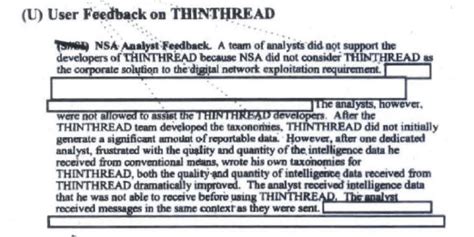
Operation ThinThread was a highly classified U.S. National Security Agency (NSA) signals-intelligence (SIGINT) program developed in the late 1990s. It is most often discussed today because of what it represented—a technically sophisticated, privacy-protective alternative to later mass-surveillance programs, most notably Trailblazer, and by extension, post-9/11 bulk data collection efforts.
Below is a clear, structured explanation with context, technology, controversy, and legacy.
⸻
1. What ThinThread Was
ThinThread was an automated intelligence analysis system designed to:
•Rapidly analyze vast volumes of global communications metadata
•Detect terrorist networks and suspicious communication patterns
•Protect U.S. citizens’ privacy by design
It focused primarily on metadata (who contacted whom, when, how often, from where), not the content of communications—years before “metadata” became a household term.
⸻
2. Core Technical Innovations
ThinThread was far ahead of its time. Key components included:
A. Advanced Metadata Analysis
•Mapped social networks of communications
•Detected anomalies and emerging patterns
•Used link analysis to identify hubs, facilitators, and covert networks
This allowed analysts to see relationships, not just isolated messages.
⸻
B. Automated Encryption for Privacy
One of ThinThread’s most significant features:
•U.S. persons’ data was automatically encrypted
•Analysts could not see identities without a warrant
•Decryption required legal authorization
This was privacy protection built into the system itself, not added later as policy.
⸻
C. Real-Time Alerts
ThinThread could:
•Generate alerts when suspicious communication patterns emerged
•Reduce analyst overload by prioritizing high-risk signals
This addressed a major intelligence failure of the era: too much data, not enough insight.
⸻
3. ThinThread vs. Trailblazer
ThinThread’s fate is inseparable from Trailblazer, a competing NSA program.
|
ThinThread |
Trailblazer |
|
Developed in-house by NSA engineers |
Largely outsourced to defense contractors |
|
Relatively low cost (millions) |
Extremely expensive (billions) |
|
Automated privacy protections |
No built-in privacy safeguards |
|
Functioning prototype |
Largely failed to deliver |
|
Emphasized metadata intelligence |
Emphasized bulk collection |
Despite ThinThread’s effectiveness, the NSA cancelled it in favor of Trailblazer around 2000–2001.
⸻
4. The 9/11 Controversy
After the September 11 attacks, former NSA officials involved with ThinThread made explosive claims:
•ThinThread may have detected some 9/11-related communications
•Alerts reportedly existed but were not acted upon
•The system was never fully deployed operationally
While this claim remains debated and partially classified, it fueled intense scrutiny of NSA decision-making.
⸻
5. Whistleblowers and Internal Dissent
Several senior NSA figures later became whistleblowers or public critics:
•William Binney – NSA mathematician and ThinThread co-creator
•J. Kirk Wiebe – Senior NSA analyst
•Edward Loomis – Former NSA technical director
They argued:
•ThinThread worked
•Trailblazer failed
•NSA leadership prioritized contractor relationships and bureaucracy over effectiveness and civil liberties
These individuals later faced investigations, raids, and professional retaliation—adding to the controversy.
⸻
6. Relationship to Post-9/11 Surveillance
After 9/11, the U.S. intelligence community moved toward:
•Bulk collection of domestic and international communications
•Programs later revealed by Edward Snowden
Ironically:
•ThinThread offered stronger privacy protections than programs that replaced it
•Snowden himself later referenced ThinThread as a missed opportunity
⸻
7. Why ThinThread Matters Today
ThinThread is often cited as a cautionary tale:
A. Technological Lesson
•Smart analysis > mass data hoarding
•Metadata can be extremely powerful when used properly
B. Civil Liberties Lesson
•Privacy protections can be engineered, not just legislated
•Oversight can be embedded at the system level
C. Institutional Lesson
•Bureaucratic incentives and contractor economics can override better solutions
•Internal dissent in intelligence agencies is often punished rather than examined
⸻
8. In One Sentence
Operation ThinThread was a sophisticated, privacy-protective NSA surveillance system that may have worked too well—and was abandoned in favor of more expensive, less effective, and more intrusive alternatives.



 Swansenreport
Leave a comment