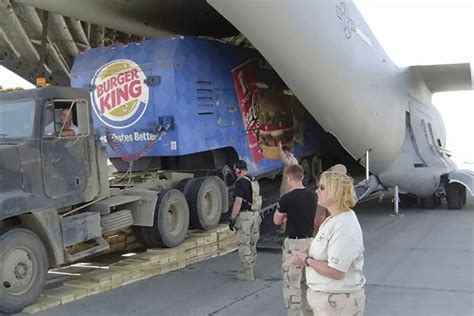
The idea of a deployable Burger King sounds like urban legend—but it’s very real, and it sits at the intersection of military logistics, morale management, and modern expeditionary warfare.
Below is a clear breakdown of what it is, how it works, why it exists, and why it matters.
What Is the U.S. Military’s Deployable Burger King?
The U.S. military has, at various times, deployed fully functional Burger King restaurants (and other fast-food brands) to overseas bases and combat zones—most notably during the Iraq and Afghanistan wars.
These are not symbolic pop-ups. They are:
-
Real Burger King menus
-
Real flame-broiled Whoppers
-
Real branded signage
-
Operated by civilian contractors
-
Built inside hardened or modular facilities
In short: a genuine Burger King in a war zone.
Who Runs Them?
The military itself does not cook Whoppers.
Instead, the Department of Defense contracts with large logistics and food-service firms, historically including:
-
KBR (Kellogg Brown & Root)
-
Fluor
-
Vectrus
These contractors then sublicense brands like:
-
Burger King
-
Pizza Hut
-
Subway
-
Taco Bell (in limited cases)
The contractors staff the restaurants primarily with third-country nationals (workers from places like the Philippines, India, Nepal, Uganda, etc.), not U.S. soldiers.
Where Have They Been Deployed?
Deployable Burger Kings have appeared at major U.S. bases such as:
-
Camp Victory (Iraq)
-
Balad Air Base (Iraq)
-
Bagram Air Base (Afghanistan)
These were large, semi-permanent installations—essentially small American cities overseas, complete with gyms, PXs, coffee shops, and fast food.
They are not deployed to front-line firefights or temporary patrol bases.
How Is a Burger King Deployed?
1. Infrastructure First
A base must already have:
-
Secure perimeter
-
Reliable power
-
Potable water
-
Waste management
-
Supply routes
2. Modular Construction
Burger Kings are built using:
-
Prefabricated structures
-
Containerized kitchens
-
Hardened dining areas
-
Blast-resistant materials where necessary
3. Supply Chain
Ingredients are shipped via:
-
Military airlift
-
Contracted cargo flights
-
Regional supply hubs
Everything from beef patties to paper cups is tracked through military logistics systems.
Why Would the Military Do This?
This is the most important part.
1.
Morale Is Combat Power
Modern militaries recognize morale as a force multiplier.
-
A familiar meal from home
-
A break from MREs
-
A sense of normalcy
These things materially affect:
-
Mental health
-
Retention
-
Discipline
-
Long-term effectiveness
A Whopper can’t win a battle—but it can help someone get through a year-long deployment.
2.
Retention and Professionalization
The U.S. military is an all-volunteer force.
Providing:
-
Comforts
-
Familiar brands
-
Quality food
…helps retain experienced personnel in long, repetitive conflicts.
3.
Logistics Testing at Scale
Running a Burger King in a war zone is also a stress test of U.S. logistical dominance:
-
Cold chains
-
Fuel logistics
-
Contract management
-
Infrastructure reliability
If you can run a fast-food franchise in Iraq, you can sustain far more critical operations.
4.
Soft Power (Internally and Externally)
To troops:
“Your country values your comfort.”
To allies and observers:
“The U.S. can project not just force, but lifestyle.”
To critics:
“We are here long enough to build restaurants.”
This cuts both ways.
Criticism and Controversy
Deployable Burger Kings have been controversial for several reasons:
1.
Cost
A Whopper overseas can cost taxpayers many times more than stateside due to:
-
Transport
-
Security
-
Contractor overhead
Critics argue the money should go to:
-
Veterans’ care
-
Equipment
-
Training
2.
Cultural Optics
Images of Burger Kings in Iraq became symbolic of:
-
Cultural insensitivity
-
“Americanization” of war
-
Imperial overtones
To some, it looked less like liberation and more like occupation.
3.
Two-Tier System
There were stark contrasts between:
-
Large bases with fast food
-
Small outposts surviving on MREs
This sometimes bred resentment among troops in more dangerous postings.
Why You Don’t See Them as Much Today
The U.S. military has shifted doctrine toward:
-
Smaller footprints
-
Rapid deployment
-
Fewer permanent bases
As a result:
-
Fewer fast-food franchises
-
More emphasis on improved field rations
-
Modular dining without brand licensing
The deployable Burger King era peaked between ~2003–2014.
The Bigger Picture
The deployable Burger King tells a deeper story:
-
The U.S. military is not just a fighting force—it’s a global logistics organism
-
Modern war includes psychology, comfort, and routine
-
Power projection now includes culture, brands, and lifestyle
It’s one of the clearest examples of how 21st-century warfare blends civilian life with military operations.

 Swansenreport
Leave a comment