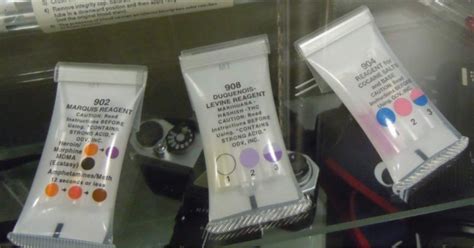
An Overview
Colorimetric drug tests work by applying a chemical reagent to a substance, which produces a color reaction that indicates the presence (or absence) of a particular compound. They’re used by law enforcement, harm reduction organizations, forensic labs, and individuals. Here’s a thorough look at both sides.
How They Work
A reagent — typically a strong acid like sulfuric or hydrochloric acid mixed with other compounds — reacts with the molecular structure of a drug to produce oxidation byproducts that appear as specific colors. Common reagents include Marquis, Mecke, Mandelin, Simon’s, Froehde, and Scott, each targeting different substance classes.
The Pros
Cost and accessibility. Colorimetric tests are cheap — often just a few dollars per test — and widely available. They require no electricity, no lab equipment, and no specialized training to perform, making them practical in the field.
Speed. Results appear within seconds to a few minutes. For law enforcement making a roadside determination, or a harm reduction worker at an event, that immediacy is valuable.
Portability. The kits are small, self-contained, and require no infrastructure. A single officer or outreach worker can carry dozens of them.
Harm reduction value. Organizations like DanceSafe have used these tests effectively to help people identify dangerous adulterants in recreational drugs. The rise of fentanyl in the drug supply has made this application particularly significant, though fentanyl test strips have largely supplanted colorimetric tests for that specific threat.
No sample destruction (relatively). Only a small amount of material is consumed, leaving most of a sample available for confirmatory testing.
Broad screening ability. A panel of different reagents applied to the same sample can narrow down the likely substance class considerably.
The Cons
Not definitive — false positives and false negatives are common. This is the biggest limitation. Many structurally similar compounds produce identical or overlapping color reactions. A colorimetric test cannot distinguish between MDMA and MDA, for instance, or between methamphetamine and certain common medications. This has led to wrongful arrests and prosecutions.
Mixture problem. Real-world drug samples are rarely pure. When multiple substances are present, colors blend and overlap, making interpretation extremely difficult or impossible. The dominant compound may mask others entirely, which is especially dangerous when a potent adulterant like fentanyl is present in trace quantities.
Subjective interpretation. Color perception varies between individuals and lighting conditions. What one person reads as “blue-green” another reads as “teal.” There is no objective measurement, and no permanent record of the result. This subjectivity has been a serious issue in criminal cases where the test was the sole or primary evidence.
Legal and evidentiary concerns. Courts in many jurisdictions have become increasingly skeptical of colorimetric field tests as standalone evidence, and for good reason. The Innocence Project and journalists have documented hundreds of cases where people pleaded guilty based on false positive field tests — particularly involving common substances like soap, chalk dust, vitamins, and legal medications triggering positive cocaine or meth results.
Can’t determine quantity. They’re qualitative, not quantitative. You know nothing about concentration or dose from the color result alone.
Reagent degradation. The chemicals have shelf lives and are sensitive to temperature and contamination. An old or improperly stored kit can produce unreliable results without any obvious indication that something is wrong.
Limited substance coverage. Each reagent only reacts meaningfully with certain compound classes. No single test or even standard panel covers all drugs, and novel psychoactive substances (NPS) or designer drugs frequently produce unexpected or no reactions.
The Bottom Line
Colorimetric tests are best understood as a preliminary screening tool, not a confirmatory one. Their value is highest when used as a first pass that triggers follow-up with gas chromatography-mass spectrometry (GC-MS) or other laboratory analysis. The problems arise — legally and practically — when they’re treated as conclusive. In harm reduction contexts, where the goal is risk awareness rather than prosecution, their cost-speed-accessibility tradeoff is generally favorable. In criminal justice contexts, relying on them heavily has caused demonstrable harm to defendants and eroded trust in the process.



 Swansenreport
Leave a comment