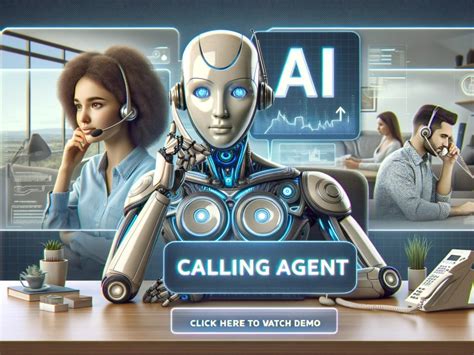
I’ve received a call like this on several occasions. After 10 secons or so, it is very apparent, at least to me that the “caller,” wasn’t real. I’ve worked in several call centers, and it’s evident when taking a phone call, it the caller is a seasoned call center individual or a newbie. It is very painful to have to listen to a newbie reading from their prepared script. The AI Agent’s I’ve encountered have been just as sad. There has been no human voice variation or resonance. They have sounded hollow and forced, and I’d hate to think of attempting to have a face to face conversation with one.
Now you’ve probably gotten one of these calls by now. The voice is a little too smooth, never stumbles, never breathes awkwardly, never says “um.” It asks if you have a minute to talk about your business’s online presence, or your insurance renewal, or whether you’d like to schedule a demo. You talk back, and it actually responds — contextually, naturally, without missing a beat. Something feels slightly off but you can’t quite put your finger on it. Then it hits you: there’s nobody on the other end of this call.
Welcome to the age of AI voice agents, and they are proliferating faster than most people realize.
ElevenLabs, the company behind many of the most convincing AI voices in circulation, closed a $500 million funding round in February 2026, achieving an $11 billion valuation — more than triple what it was worth just one year prior. The round was led by Sequoia Capital, with Andreessen Horowitz quadrupling down on its position. The company closed 2025 at $330 million in annual recurring revenue, driven by enterprise customers including Deutsche Telekom, Square, and Revolut. This is not experimental technology. It is production infrastructure, running at scale, handling millions of calls. The Daily Beast
ElevenLabs’ agents are no longer simple voice bots. They are what the company calls “proactive participants in business workflows” — capable of booking appointments, processing payments, checking CRMs, and handling complex multi-turn conversations in real time, mid-call. A proprietary turn-taking model handles human-like pauses and hesitations, knowing when to listen and when to speak, even if the caller interrupts. The National Desk
The social media post that caught my eye this week put it bluntly: build an AI receptionist for local businesses — dentists, salons, clinics — for eight cents a minute, and replace $2,000 to $5,000 a month in human labor. That’s not a pitch deck fantasy. Using Bureau of Labor Statistics median pay for customer service representatives at $19.08 an hour, an extra ten seconds of avoidable handle time across 10 million calls in a year amounts to roughly $530,000 in wages before benefits and overhead. The math is devastating for anyone whose job involves answering a business phone. Democracy Docket
The shift happening right now is from reactive to proactive — AI agents that don’t just answer questions but anticipate needs, detect frustration in a caller’s voice and adjust tone accordingly, and manage multilingual conversations seamlessly. Five years ago, voice assistants were a novelty. Today, anything less than this level of sophistication is considered outdated by the companies deploying these systems. UPI
There are legitimate uses — restoring communication to people with ALS who have lost their voices, language accessibility, 24/7 small business coverage that no human staff could provide. And there are less legitimate ones: mass outbound calling campaigns built specifically to deceive recipients into thinking they’re talking to a person.
The cultural moment here is worth sitting with. The erosion of the human voice as a signal of human presence is happening in real time, one phone solicitation at a time. Most people haven’t consciously registered the shift yet — they just feel vaguely uneasy and can’t explain why. The technology is already far ahead of public awareness, let alone regulation.
Sources: ElevenLabs | Startup Wired | IBM/ElevenLabs Partnership | ElevenLabs Developer Trends | Workd Insights





Leave a Reply