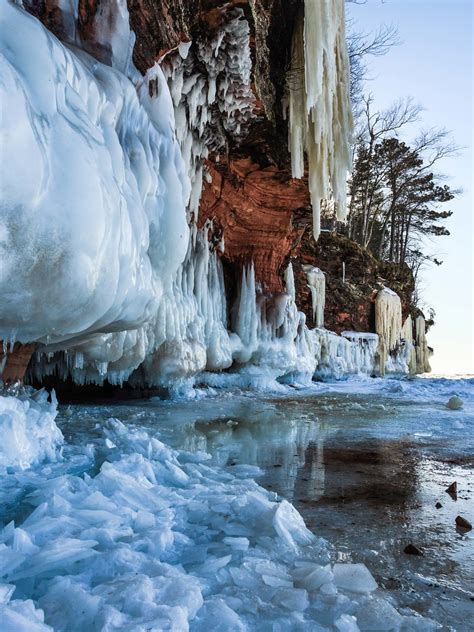
If you blinked on February 16, 2026, you missed it. For the first time since 2015, the ice caves at Apostle Islands National Lakeshore opened to the public — and then, barely 24 hours later, a gale off Lake Superior erased them.
The sea caves along the mainland cliffs near Meyers Beach are a geological marvel in any season. Carved over centuries by the relentless action of Lake Superior’s waves, the sandstone formations near Bayfield draw visitors year-round. In warmer months, kayakers paddle directly into the caves to admire their sculpted red walls. But in the depths of a proper Wisconsin winter, those same caves transform into something else entirely — a frozen gallery of ice columns, curtains, and cathedral-like chambers, accessible only by walking across a frozen Great Lake.
That winter transformation is breathtakingly rare. Stable ice at Meyers Beach requires months of sub-zero temperatures, low winds, and calm wave conditions. The last time the caves were safely open was 2015. Before that, a brief three-week window in 2014 drew an estimated 138,000 visitors. Prior to 2014, conditions hadn’t been suitable since 2009.
So when the National Park Service announced on February 16, 2026 that conditions were suitable for public access, the region erupted. The Apostle Islands National Lakeshore sold roughly 2,500 special-use recreation permits for that Monday alone. Families trekked across the frozen surface of the lake to stand inside caves draped in ice — a scene that more than one visitor described as something out of a fairytale.
By Tuesday morning, it was over. A forecasted winter storm prompted the NPS to proactively close access Monday night. Wind gusts pushing over 40 mph battered the ice through Tuesday and into Wednesday. By noon on February 18, remote cameras operated by the University of Wisconsin-Madison’s Sea Caves Watch showed open water where thousands of people had stood just two days before. The ice shelf had broken up in less than 16 hours.
For those planning a summer trip to the area, the caves are very much alive. Guided kayak tours launch from Bayfield throughout the warm season, with outfitters offering routes along the mainland sea caves at Meyers Beach and offshore at spots like Devils Island. The west side of the Bayfield Peninsula offers the most dramatic cave formations, though conditions there are more exposed and can shift quickly. Local guides monitor real-time wave data from the UW-Madison Sea Caves Watch site and the NOAA station at Devils Island before heading out.
If you want to hike rather than paddle, the Lakeshore Trail from Meyers Beach offers sweeping views of the mainland caves — dramatic red sandstone cliffs, expansive Lake Superior vistas, and some of the most photographed scenery in the upper Midwest. Spring is a particularly good time to visit, with cooler hiking temps and smaller crowds.
As for the ice caves — well, that’s Lake Superior’s call. The 2026 season lasted one remarkable day. The next window could be years away. If you live anywhere near Bayfield, it pays to keep an eye on the NPS alerts and be ready to drop everything when conditions align.






Leave a Reply