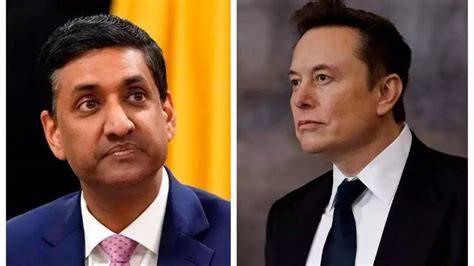
Elon Musk said Monday he plans to sue Rep. Ro Khanna (D-CA) after the congressman accused the tech billionaire of “possibly sentencing to death” 4.5 million children around the world through his work dismantling USAID as the symbolic head of the Department of Government Efficiency.
“Time to sue this liar,” Musk posted on X, responding to a New York Post story about Khanna’s weekend comments on the I’ve Had It podcast. Musk followed that with a defense of DOGE’s methodology: “The standard applied by DOGE was very simple and easy: Provide contact information for the recipients of aid, so that we can confirm it is not fraudulent.”
Khanna, who represents a Silicon Valley district closely tied to Tesla’s workforce, didn’t back down. “There needs to be accountability for Elon Musk,” he said on the podcast. “They’re celebrating that he created 4,400 millionaires, but they don’t talk about the 4.5 million children around the world who he possibly sentenced to death by dismantling USAID. He needs to be subpoenaed. He needs to face investigation.”
The 4.5 million figure isn’t a body count — not yet. Khanna drew it from a peer-reviewed study published in The Lancet projecting that severe USAID cuts could lead to more than 14 million additional deaths by 2030, including more than 4.5 million children under age 5 if reductions continue. Musk, who became the world’s first trillionaire earlier this month following SpaceX’s IPO, called it a lie and accused Khanna of insider trading. Musk said USAID money was “being sent to corrupt politicians under the guise of aid” — pointing to cases in which USAID officials had been charged and pleaded guilty in a bribery scheme.
For Wisconsin, the argument is less abstract than it might seem from Bayfield County.
Wisconsin dairy farmers have long had a financial stake in USAID’s food aid programs. The agency’s nutrition interventions — including Ready-to-Use Supplementary Foods for malnourished children — relied heavily on U.S. milk powder as a key ingredient. The National Milk Producers Federation and the U.S. Dairy Export Council both praised USAID’s Food for Peace purchasing as creating “steady demand for milk powders” that benefited American producers, including those in the Dairy State. When those programs go dormant, Wisconsin processors feel it downstream.
And the disruption didn’t stop at the water’s edge. Earlier this year, the USDA halted reimbursements for the Dairy Business Innovation program — a Farm Bill initiative that had provided innovation grants to Wisconsin dairy operations. A micro-dairy operator in Freedom, Wisconsin, Two Guernsey Girls Creamery, had already taken out bank loans and bought equipment on the expectation that her nearly $100,000 DBI grant would be honored. The USDA reversed that freeze after pressure from Sen. Tammy Baldwin and dairy industry leaders, but the whiplash was real.
Simultaneously, USDA cut the Local Food Purchase Assistance and Local Food for Schools programs, eliminating $10.96 million from Wisconsin’s agricultural economy and leaving 289 Wisconsin farmers without guaranteed buyers. The Hunger Task Force in Milwaukee lost more than 300,000 pounds of food — about $615,000 worth — when TEFAP emergency distributions were canceled without notice.
The administration has since moved the Food for Peace program from USAID to USDA and allocated $452 million for U.S. commodity purchases, including milk powders, framing it as an “America First” approach that routes humanitarian purchasing through American farmers. Whether that’s a genuine correction or a rebranding of a diminished program depends on whom you ask and which spreadsheet you’re reading.
What’s not in dispute is that Musk’s DOGE swept through these programs before the administration sorted out what it wanted to keep. Wisconsin farmers and food banks absorbed those disruptions in real time, with no warning and no transition plan.
Musk’s lawsuit threat against Khanna faces its own skepticism. Defamation suits against elected officials for statements made in political contexts — especially when hedged with words like “possibly” — are historically difficult to win. Khanna did not allege a fact; he made a projection-based moral argument. Courts treat those differently.
The fight, for now, is political. Khanna has said Democrats should pursue subpoenas if they retake the House or Senate this fall. Musk, flush with trillionaire standing and a history of filing suits that generate headlines more than verdicts, is betting the lawsuit threat itself does the work.
Wisconsin’s dairy farmers spent months navigating the fallout from these decisions. They know the stakes in a way the X timeline doesn’t capture.
Sources: Mediaite, Washington Examiner, Morning Honey (The Lancet study reference), Wisconsin Examiner, NPR/WUWM, Civil Eats, Racine County Eye, USDA Foreign Agricultural Service, Feedstuffs, National Milk Producers Federation


Leave a Reply