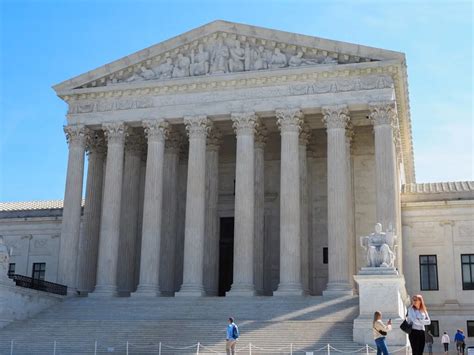
The Supreme Court ruled 6-3 Thursday that the federal government can end Temporary Protected Status for hundreds of thousands of Haitian and Syrian immigrants. The decision landed today — the same day it was handed down.
Writing for the majority, Justice Samuel Alito held that the TPS statute’s language barring judicial review “is clear, and its plain meaning is very broad,” stripping lower courts of authority to second-guess the administration’s termination decisions. The injunctions keeping the program alive through litigation are gone. SCOTUSblog
The ruling directly impacts roughly 350,000 Haitian immigrants and 6,000 Syrians who have lived and worked legally in the United States under the program. For many, the clock is now running. Ilabacalaw
Wisconsin’s Seventh District representative wasted no time. “Haiti has been under ‘Temporary’ Protected Status since 2010. Syria has been under ‘Temporary’ Protected Status since 2012,” said Rep. Tom Tiffany. “Over 14 years later, we are finally putting the ‘T’ back in TPS.” CBC News
The program’s origins are not complicated. Congress created TPS in 1990 to protect foreign nationals who cannot safely return home due to natural disaster, armed conflict, or other extraordinary conditions. Haiti was designated in 2010 after an earthquake killed more than 300,000 people. Syria followed in 2012, as Bashar al-Assad’s government launched a brutal crackdown on civilians. Both designations were renewed repeatedly because conditions in each country never improved enough to justify ending them — until this administration decided they had. SCOTUSblog
The race discrimination argument at the heart of the Haiti case didn’t move five justices. Alito wrote that statements by Trump and then-DHS Secretary Kristi Noem about conditions in Haiti were “not overtly racial” and could rest on race-neutral justifications. The majority also noted the administration had terminated TPS for 13 countries across multiple continents. Roll Call
Justice Elena Kagan wasn’t buying it. She wrote that Trump’s comments show race played a role, noting that Haitians are Black and that the references in those statements — to filth, disease, and primitiveness — “are shot through with racial stereotypes and tropes.” In her dissent, Kagan wrote that the TPS holders “ask for only one thing: that they may stay in this country while they continue to litigate their claims” — and that they deserved that relief rather than being “consigned to devastating, and indeed life-threatening, injury.” Angelus NewsSCOTUSblog
The ruling doesn’t deport anyone by itself. The court made no finding that Haiti or Syria is safe. Its holding was that courts generally cannot review the Secretary’s termination decisions — not that return is safe. Cases go back to lower courts, but the injunctions are gone. Ilabacalaw
What comes next is the harder question. Once individual statuses expire, TPS holders lose legal work authorization and driver’s licenses — throwing employment, mortgages, and daily lives into immediate legal limbo. From there, options are narrow: adjust status through asylum or family sponsorship, leave voluntarily, or face deportation. Newsweek
These aren’t abstractions. According to the American Immigration Council, more than 164,000 Haitian TPS holders earned $3.9 billion in total household income, paid nearly $984 million in taxes, and held $2.9 billion in spending power. People in American communities. American jobs. American mortgages. American Immigration Council
United Nations data shows gang violence in Haiti has driven internal displacement to a record 1.5 million people. Syria remains mired in localized militia warfare, with 6 million residents internally displaced and basic medical infrastructure largely broken. The Supreme Court didn’t dispute any of that. It ruled those facts aren’t its problem to weigh. Newsweek
Tiffany might call that putting the T back in temporary. Others would call it putting people on a plane to a country that hasn’t been safe since before some of their American-born children started school.
Sources: SCOTUSblog (Amy Howe, June 25, 2026); Roll Call (Michael Macagnone, June 25, 2026); Spectrum News (June 25, 2026); Newsweek (June 25, 2026); CBC News (June 25, 2026); American Immigration Council (April 2026); Mullin v. Doe, No. 25-1083, slip opinion (June 25, 2026).





Leave a Reply