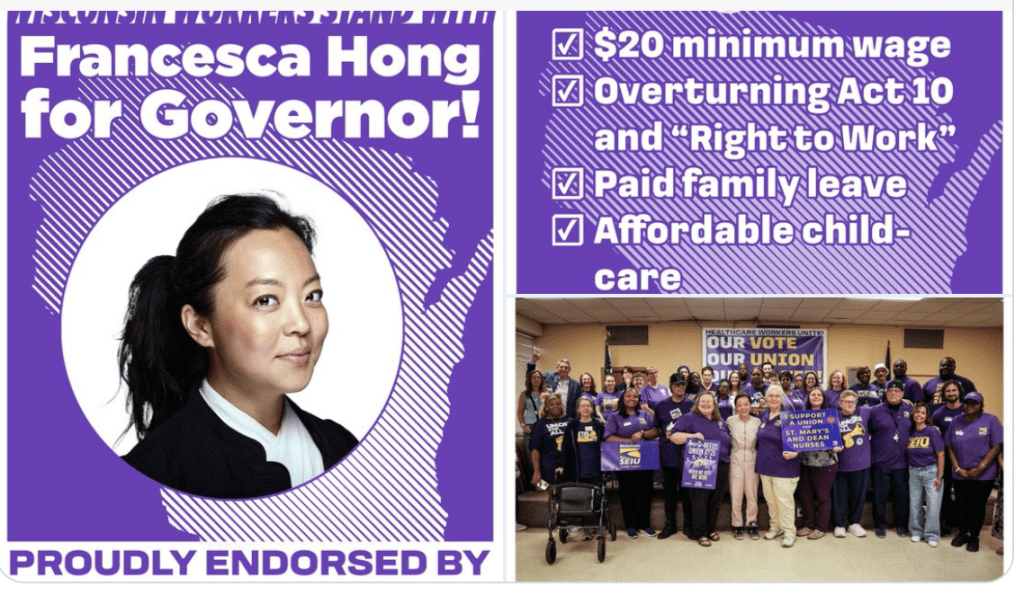
Given the unrest across the country and with state primaries and the Mid Terms up coming this is a story that we all should be paying attention to. (See featured image on trends across Wisconsin)
New York City wants to run five grocery stores. It does not, as of this week, have five locations, five operators, or a settled name for the store in East Harlem — the site listing calls it 1658 Park Avenue in one place and 1590 Park Avenue in another, an inconsistency that survived all the way to publication. But the city does have a 44-page Request for Proposals, released July 27 by the New York City Economic Development Corporation, and it answers most of the questions that mattered less to a wave of mocking headlines than the actual mechanics do.
Mayor Zohran Mamdani campaigned on the idea last year: city-owned supermarkets, one per borough, selling a defined list of groceries at prices averaging 30 percent below retail. The RFP is the document that turns that pledge into a procurement process, and it’s due back to the city by October 16. Buried in its appendices are the details that make the plan either a serious municipal intervention or an accounting mess, depending on who’s reading it.
Start with the joke that’s been circulating online — that the city wants stores with no deli counter that still have to sell deli salads. That one’s true, more or less. The RFP states plainly that the stores “will not include facilities for onsite food preparation, such as deli counters or butcher counters,” but operators are still expected to stock “certain pre-packaged items traditionally prepared in such facilities, such as meats and cheeses.” Appendix C, the Core Basket list, goes further: alongside produce, fresh meat, seafood and a long roster of pantry staples, there’s a category labeled simply “Deli,” covering specialty cheeses and prepared salads — chicken, egg, fruit, potato, bean. None of it can be made in the store. All of it has to show up pre-packaged from somewhere else. It’s not quite Alice in Wonderland. It’s closer to a supply-chain workaround dressed up as a menu category.
The money is where the document gets more interesting than the punchlines suggest. The city is covering three things outright: construction and fit-out of each store, rent for the life of the agreement, and property taxes. Beyond that sits something the RFP calls an Affordability Payment — a subsidy meant to close whatever gap remains between what an operator can discount on its own and the 30 percent target the city wants. Here’s the twist: NYCEDC doesn’t set that number. Respondents do. They’re asked, first, what discount they could offer with no subsidy at all, using only the free rent and free real estate. Only if that number falls short of 30 percent do they request a subsidy to make up the difference — and whoever asks for the smallest number wins the largest score on that portion of the bid, worth 20 percent of the total evaluation. It’s a reverse auction dressed up as a grant application, and it puts real pressure on operators to lowball their own costs to win the contract.
No dollar figure for any of this appears in the RFP itself. The $70 million capital number that’s been repeated in coverage came from the Mayor’s Office press release, not the procurement document. That’s worth flagging for anyone reading past the headlines: the city’s own solicitation, the thing prospective operators actually have to respond to, contains no published budget.
Two sites are locked in. The Bronx location sits inside a mixed-use development called The Peninsula in Hunts Point, on the site of the old Spofford Juvenile Detention Center, targeting an opening in the second half of 2027. The surrounding half-mile carries 26,000 residents, an average household income of $56,700, and 52 percent of households on SNAP — among the highest concentrations of federal food assistance reliance the city could have chosen for a flagship location. The Manhattan site is a vacant lot in La Marqueta, East Harlem, requiring ground-up construction the city will fund and manage itself, with an opening target pushed out to 2029. That neighborhood skews wealthier and denser — $84,900 average household income, 66,000 residents within a half mile, 37 percent on SNAP. Brooklyn, Queens and Staten Island have no sites at all yet. Respondents bidding on those boroughs are told to just assume 15,000 square feet and build their numbers from there.
What isn’t in the document may matter as much as what is. There’s no liquidated-damages clause, no penalty for a missed opening date, no termination-for-convenience provision, and no wind-down process if an operator wants out. The RFP sets target dates — late 2027 for the Bronx, 2029 for Manhattan — and then, in 44 pages of terms and conditions, attaches no stated consequence to missing either one. The closest thing to a hook is a clause letting the city withhold Affordability Payments if an operator breaches whatever contract eventually gets negotiated, but that contract doesn’t exist yet, and neither does a defined penalty structure inside it.
Skeptics have pointed to Kansas City’s decade-long, taxpayer-subsidized attempt at a municipal grocery store, which closed for good this year after roughly $18 million in public money failed to keep it solvent. Whether New York’s version fares differently will come down to details this RFP leaves open — how quickly NYCEDC actually delivers the promised construction, how aggressively operators lowball their subsidy requests to win the bid, and what happens in year three if a 30 percent discount turns out to be more expensive to sustain than anyone modeled going in.
Proposals are due October 16. NYCEDC holds an information session August 5 and site tours in mid-August. Nothing about site selection, subsidy amounts, or operator identity will be settled before then.
Sources: N.Y.C. Groceries Program Operator(s) Request for Proposals, New York City Economic Development Corporation, released July 27, 2026 (44 pp.), including Appendix C (Core Basket), Appendix D (Descriptions of Identified Sites), Appendix E (Affordability Payment Estimate Assumptions Table) and Appendix I (RFP Terms and Conditions); NYCEDC press release, “Mayor Announces N.Y.C. Groceries Vision and RFP for Private Operator,” July 27, 2026; NYC Mayor’s Office announcement on Core Basket pricing, July 27, 2026.

 Swansenreport
Leave a comment