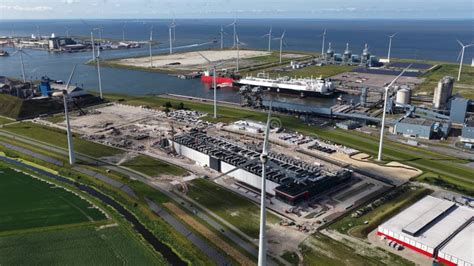
When Google built its data center in 2016 in Eemshaven, it chose water cooling because it’s more energy-efficient than air cooling, and less energy means fewer emissions and more efficient use of renewables. Google
The drought problem pushed them further. Google partnered with North Water, a Dutch water treatment company, to harness water from a network of canals to cool the data center. The €45 million project included construction of a pipeline capable of carrying 10 million cubic meters of water per year to the data center, along with a new treatment plant. Google
The engineering involved is impressive. It required building and burying a 28-kilometer pipeline from the Eems Canal in Garmerwolde to Eemshaven. Google, the government, and North Water — which treats the canal water so it can run through the cooling towers — all worked together. The treated canal water recirculates multiple times within the data center before being released into the nearby Wadden Sea. Google
The treatment plant processes canal water using coagulation by dosing iron, followed by tilted plate separators and a sand filter. Google uses two forms of water cooling — closed and open systems — which reduces water consumption by more than 50 percent compared to single-pass cooling. Dutchwatersector
The Floating Data Center Innovation
Beyond pipelines, the Netherlands has taken things a step further with floating facilities. The country is pioneering floating data centers built directly on its extensive network of canals and waterways. Through advanced heat exchange systems, cool water is circulated within the facility to absorb heat generated by servers. The warmed water is then released back, dissipating heat without high-energy mechanical cooling systems. Ecospherenews
Cooling accounts for 30–40% of a data center’s total energy consumption. Traditional systems rely on mechanical refrigeration, which is both electricity-intensive and carbon-heavy. The Dutch approach replaces this with heat exchange using ambient water. The canal water concept also solves a land problem: in densely populated cities like Amsterdam, where space is limited and expensive, utilizing waterways allows expansion of digital infrastructure without competing for valuable land. Maker Faire RomeEcospherenews
The Tension: Sustainability vs. Water Stress
It’s not all clean and green. Data centers in North Holland use so much water to cool equipment that officials warned of potential drinking water shortages for households. Two existing data centers in the municipality of Hollands Kroon consume 525 cubic meters of drinking water per hour — roughly 4.6 million cubic meters per year, equivalent to more than 28,000 four-person households. With permits pending for five more data centers, cooling water demand could climb by an additional 10 million cubic meters annually. Datacenter Forum
There are also chemical concerns. Chemicals used to kill bacteria and prevent lime deposits in cooling water are being discharged back into surface water, canals, and the IJsselmeer. Datacenter Forum
Where It’s Headed
Google has now broken ground on a fourth Dutch data center, this one in Westpoort, with an investment of more than €600 million. In total, Google has invested more than €3.8 billion in Dutch data centers and digital infrastructure. Data Center Dynamics
Experts suggest the floating data center model could serve as a blueprint for other water-rich cities worldwide, as global data demand continues to surge with the growth of artificial intelligence, cloud computing, and smart urban systems. The underlying principle, as one analysis put it, is turning canals into cooling systems — treating water as an ally rather than an obstacle. Maker Faire Rome
The tension between innovation and resource pressure is real, though. The Netherlands invented the idea of making land from water. Now it’s trying to make computing from water — and figuring out how much of both it can afford.






Leave a Reply